
Product · Live
BidDibs: what a bid package says, and where
BidDibs turns a public bid package into a short kill sheet of the requirements it states, each with its page number, for small contractors bidding public work. This is how it came about, the choices behind it, and what comes next.
Visit siteThe problem I saw
From 2016 to 2022 I led marketing for PACE's Business Division, which supports small businesses across LA County. Part of that work was helping launch its procurement services, and that's where I saw the problem BidDibs is built around.
Public agencies publish bid packages for the work they want done. Somewhere in each package are the requirements that decide whether a business can bid at all: set-asides, bonding, licensing, site visits, insurance, prevailing wage and more. Small contractors rarely have the time or the team to read the whole thing.
Help exists. APEX Accelerators, Small Business Development Centers and city and county programs have advisors whose job is to help businesses bid. But their time is limited: at PACE, a few counselors served hundreds of businesses. Every hour spent finding out what a package requires is an hour not spent on the bid itself, or on the next business waiting for a meeting.
The idea
The fix didn't need to replace the advisor. It needed to get the contractor to the meeting prepared, so the advisor's time goes further.
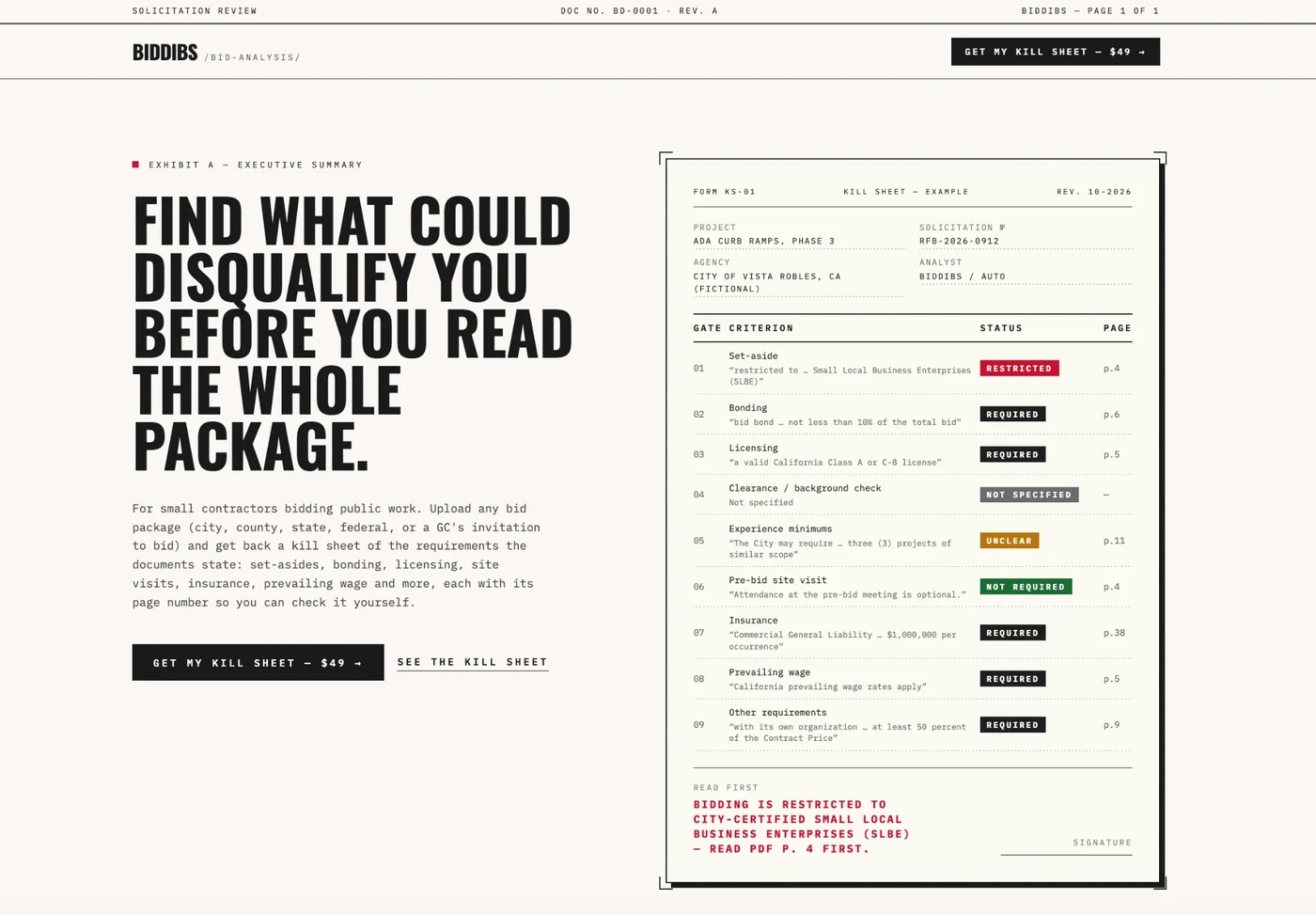
A contractor uploads a bid package, as PDFs or a zip, and gets back a short PDF kill sheet. It lists the requirements the documents state, each with a plain status label and the page it came from. The point is to see what could rule a bid out before anyone reads the whole package, and to make every line easy to check: open the package to that page and read it yourself.
The choice not to recommend
Some other tools in this space score how well a bid fits a business. BidDibs deliberately doesn't. It makes no bid or no-bid recommendation.
That call depends on things a bid package can't show: the contractor's capacity, their other work, their experience with the agency and how much risk they can take on. An advisor who knows the business is far better placed to make it with them. A score can also look more certain than the documents are. So BidDibs shows what the documents say and where, and leaves the decision to the people with the context.
How it was built
I'm not a software engineer. I built BidDibs with modern AI tools, and the first version was live in about a week.
The process is fully automated: a contractor uploads a package and the kill sheet is emailed back without anyone on my side reviewing it first. In October I added a check before any sheet goes out: software confirms that each quoted passage appears on the page it cites. If a sheet fails that check twice, it isn't sent, and I'm alerted instead. During the pilot, I'll also read a copy of each kill sheet the same day and check anything that looks off against the cited page.
Building it fast wasn't the hard part. The choices that mattered most were about what it shouldn't do:
- Each requirement it lists carries its page number, so nothing has to be taken on trust.
- Each gets a plain status label: RESTRICTED, REQUIRED, UNCLEAR, NOT REQUIRED or NOT SPECIFIED.
- If something isn't in the documents, it says "Not specified." It never guesses.
- It reads the text in the written documents, not drawings or plans, and it lists any pages it couldn't read, such as most scans.
This way of building suits working sites and tools like this one. It isn't how I'd build a large custom system, and I say so up front when scoping work.
Before telling anyone about it
BidDibs is live, but I haven't promoted it yet, so as of October 2026 it has no customers. Before telling anyone about it, I did two things. First, I checked every claim on the BidDibs site against what the product actually does. I rewrote the headline and cut claims I couldn't back up. The old homepage example and sample kill sheet used pass/fail-style labels that came too close to a bid recommendation, so I rebuilt both to match what the product does now, and changed the product's own labels too. Both show a fictional city bid, labeled as fictional. Second, I went back to the question of who would use BidDibs and how they would find it. The answer pointed back to the advisors.
The pilot
Contractors are hard to reach one at a time. Advisors already work with many of them. So the next step is a free pilot with LA County programs that help small businesses bid public contracts: APEX Accelerators, Small Business Development Centers, certification programs and agency small-business offices.
Each program gets a free code its clients can use for up to five kill sheets. Nobody using a code pays.
The pilot is also built to answer a question I can't settle by asking: who is the buyer? If contractors upload packages themselves, BidDibs is a contractor tool. If advisors run packages for their clients, programs may be the ones who pay. What people actually do with the codes will decide the paid model.
As of October 2026, outreach to programs is just starting, and no program has joined yet.
What this says about how I work
BidDibs is my own product, but it went through the same steps I use with any business. Diagnose: I started from a problem I'd seen up close, not from a technology looking for a use. Design: I decided what the tool should not do before deciding what it should. Build: I got a working version live quickly. Improve: before promoting it, I checked every claim against what it does and designed a pilot to find out who the buyer is.
If you run a program that helps small businesses bid public contracts, I'd like to hear how your clients handle bid packages today, and whether BidDibs could help. And if your business has a problem that needs both a clear diagnosis and a working tool, let's talk.
Have a problem you're trying to solve?
Tell me what's happening, what you've tried and where you're stuck. I read every message myself.